
Returning from a very full month of teaching and dharma exploration in Brazil we are delighted to announce some new publications in both English and Portuguese.
In NZ we have refined and extended, “Foundations of Mindfulness: A Manual for Meditators”. This is now available in book form where it joins “Walking in Wisdom” and “Breathing: The Natural Way to Meditate” to make what we are calling a ‘Mindfulness Trilogy’.
Foundations of Mindfulness is available for $20 NZ plus postage.
Mindfulness Trilogy, (three books) available for $50 plus postage.

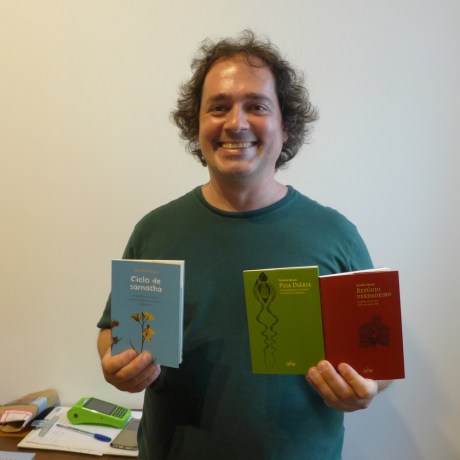
In Brazil, three new beautifully presented titles are are now available.
Puja Diaria
Ciclo de Samatha
Refugio Verdaeiro
To purchase these visit http://www.assertivamindfulness.com.br/livros/
Recently, I found myself contemplating various meanings and permutations of the word foundation: – a place where something is found, or discovered; the place or ground from which something grows or is made; the basis, firm footing, substructure, underpinning or support for something. Things don’t just appear out of nowhere. Every being or entity emerges from a foundation, a history, a unique matrix of becoming – a shared process that links us all. To discover our foundations is not a different project from discovering what we/I am.
Rather than a singular foundation, it might be more fruitful to consider the possibility of ‘poly-foundations’ or at least a multi-faceted foundation – foundation as a collection of dynamic collaborative processes: one’s physiology, family, culture, local ecology, biosphere, billions of years of evolution-in-action, ungraspable suchness, the dharmadhatu. There are so many domains and dimensions. Each is a universe of unfolding in itself – a foundation or basis of nowness. How vast is your capacity to embrace? How big a universe can you be? Whatever its shape or form, that foundation will be an expression of dynamic structure, a continuous responding to shifts and changes taking place in the other domains of foundation – worlds interpenetrating worlds.
Given the above reflections, the term foundations of mindfulness overflows with hints and intimations. Evolving life is the foundation of what we call mindfulness while, at the same time, mindfulness in action is what deepens our appreciation of this mystery. Kalu Rinpoche once described mind as “that which knows”. We could call it the field or expanse of knowing. Mindfulness/awareness/responsiveness, however we call it, is a process of continual attunement. It is a dance, a choral symphony of becoming: atom to atom, molecule to molecule, organs, organisms, creatures, ecosystems and planets; ever refining responsiveness collaborating with immeasurable other responsivenesses in the process of manifesting the living experience that we currently are. In this sense, mindfulness is a foundation for ongoing bodhisattvaship – the sublime art of being this mystery, knowing itself, living together (planetary companions) with competence, awe-struck reverence, and love.
As wholeness,
I don’t relate to any other.
Yet,
Feeling into the primordial wholeness of present living,
I sense an ocean of relatings
occurring through many domains and dimensions of being.
Relationship is what I am.
It’s what you are.
Universes inter-shaping ,
these mysteries that are each one of us.
Resting in this praxis;
mindfulness dancing all over.
Learning
as subtle blessing;
this enquiry
this speechless wondering
this unshakable stillness.
Foundation in all its ungraspable mystery.
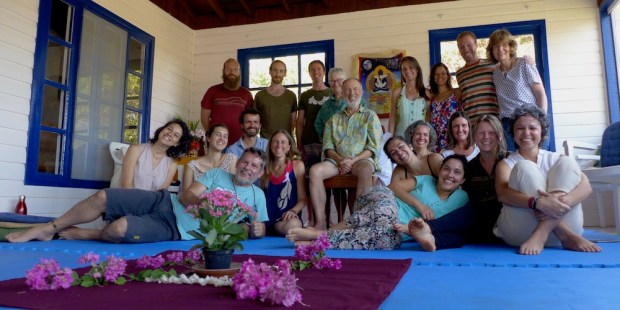
With warm thanks to everyone who helped make our recent visit to Brazil
such a rich and marvellous experience.
Sarva Mangala


 Green Dharma Treasury